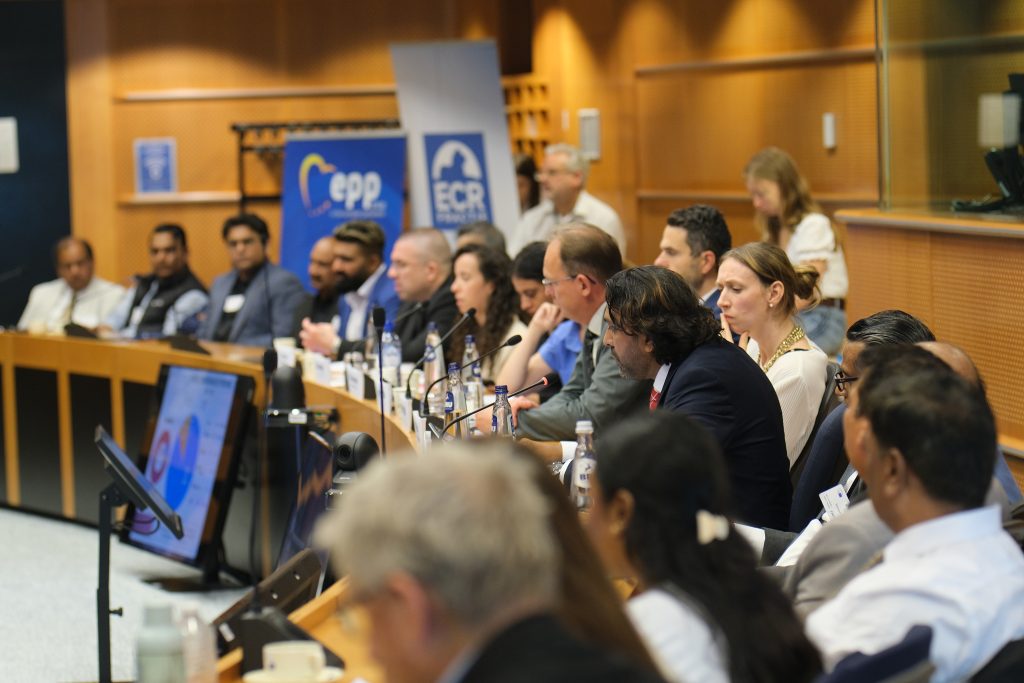

Brussels, Belgium – 14th July 2026 | Victims’ stories and plight were center stage as members of the European Parliament, legal experts, human rights advocates discuss how the EU and its Member States can “systematically raise the issue of forced conversions and marriages and the protection of religious and other minorities, political opponents, journalists, civil society and human rights defenders and activists in bilateral dialogues with Pakistan, including within the framework of the Generalised Scheme of Preferences Plus monitoring.”
The event comes on the heels of the EU resolution on the abduction, forced conversion and child marriage of Maria Shahbaz and the protection of girls in Pakistan – which passed with broad consensus last week.
Mirjam Bos with Jubilee Campaign NL opened the event emphasising the importance of bringing protection for these women and girls and expressed gratitude to MEP Bert-Jan Ruissen and MEP Matej Tonin for hosting the event.
The first panelist speaker, MEP Matej Tonin, emphasised the importance of not forgetting the most vulnerable in society and called on Pakistan not to neglect its minorities. MEP Ruissen – who was key in the passing of the EP resolution – took the floor to call for concerted action to address the abduction, forced conversion and child marriage of Maria Shahbaz and the protection of other girls, “Girls like Maria must be protected and returned to safety, not handed back to those accused of abusing them.”
Lawyer Sulema Jahangir provided concrete recommendations on how Pakistan could ensure that protection of minority girls is a reality. She raised how the law on criminalising statutory rape could and should be applied in the context of child marriages under 16 years old. But pointed however, to the lack of will in the judicial branch to follow the letter of the law and to hold perpetrators of the abductions and child marriages of minority girls accountable. She gave examples of “mischievous judgements” where judges chose to circumvent the law to justify child marriage and forced religious conversions, many times applying Islamic sharia over national laws, saying if a child has reached puberty they can be married off. She also noted how forced religious conversions cut off the Christian families from their daughters, exacerbating the road to justice.
Joseph Jansen, Advocacy Officer at Jubilee Campaign Netherlands, called out discriminatory application of the law in Pakistan, purposefully ignoring the Christian religious minority girls. He asked the question “What if it was your daughter, or the judge’s daughter?” He also welcomed the European Parliament’s recent resolution on the case of Maria Shahbaz, a 12-year-old Christian girl abducted in Lahore in July 2025 and allegedly subjected to forced conversion and child marriage.
“I would like to express my sincere appreciation to the Members of the European Parliament for adopting this important resolution,” said Jansen. “It sends a strong message that the international community is watching and expects Pakistan to protect vulnerable minority girls, prosecute perpetrators, and uphold the rule of law. It encourages us to continue,” he shares.
During the event, Jubilee Campaign Netherlands and Voice for Justice officially launched their new report, Stolen Girls: Exposing the Hidden Suffering of Christian Minor Girls in Pakistan, documenting 210 cases of abduction, forced conversion, child marriage, and sexual violence against Christian girls between 2019 and 2026.
“These are not isolated incidents,” Jansen stated. “Our research reveals a clear and systematic pattern of abuse affecting Christian minor girls across Pakistan.”
According to the report, Punjab accounted for nearly 89% of all documented cases, while 83% of the victims were under the age of 18.
“These are children—not adults freely choosing their religion or marriage partner,” Jansen said. “The average age gap between the victims and their abductors is 23 years, with many perpetrators aged between 40 and 60 years old.” The report also documents widespread manipulation of legal documents. “In 96% of documented cases, the girls’ Christian names were changed following conversion, and in 92% of cases their ages were falsified on marriage certificates to make them appear to be adults,” Jansen explained.
Joseph Jansen further highlighted serious failures within Pakistan’s justice system. “Many girls are asked to testify before a magistrate while still living under the control of their abductors,” he said. “Statements made under these circumstances cannot be considered free or voluntary, yet courts frequently rely on them together with forged documents. As a result, custody is often granted to the abductors instead of the parents.”
Referring to Maria Shahbaz, Jansen stressed that her case is not unique. “Maria Shahbaz is not an isolated case. Behind every documented case is a child whose future has been stolen and a family still waiting for justice.” Jansen called on the Government of Pakistan to criminalise forced religious conversion, ensure that abducted minors are immediately placed in independent shelter homes, investigate forged conversion and marriage documents, prosecute perpetrators and their accomplices, and strengthen child protection mechanisms.
“These girls deserve more than sympathy,” Jansen concluded. “They deserve protection. They deserve justice. And they deserve the freedom to return safely to their families.”
The full room went silent when the video of the victims’ families played and attendees turned their attention to the screens. Concern and pain filled the faces of audience members and panelists, including Pakistani diaspora from the Netherlands, Belgium and France. The families in the video pleaded with the MEPs to rescue their girls.
“Their childhood’s were robbed from them,” Anna Townsend author of the book Our Sisters: The fight for justice for Christian women forced into marriage in Pakistan, described the harrowing testimonies from the girls she interviewed.
Prof. Dr. Shobeen opened his speech by honouring his love for the country of Pakistan. He brought the discussion back to the European Parliament resolution, noting that the European Union has granted Pakistan GSP+ status, a preferential trade arrangement to promote sustainable development, good governance and respect for human rights. “This framework provides the European Union with an important opportunity to encourage Pakistan to strengthen the protection of religious minorities and to ensure that the economic benefits generated through GSP+ contribute to their social and economic inclusion,” he emphasised.
MEP Paolo Borchia joined the event at the end and showed his willingness to collaborate on religious freedom for the defence of persecuted Christians in the world.
Hulda Fahmi with Jubilee Campaign reiterated the need for the EU to ensure GSP+ status leads to implementation of the 27 conventions not just their ratification, “There should be zero tolerance for forced religious conversions and forced marriages when granting GSP+ privileges.”
Carmen Correas, Legal Officer with ADF International provided a clear summary of Maria Shahbaz case and called on EU parliamentary members to ensure judges are trained in interpreting its laws in light of Pakistan’s international law commitments.
All legal experts agreed Pakistan needs to take advantage of their National Database and Registration Authority (NADRA) to check the ages of girls before they are married off to hinder falsification of age documents, “we can’t have all these flying papers,” Sulema Jahangir emphasised.
As the EU prepares to apply its updated Generalised Scheme of Preferences (GSP) Regulation in January 2027, there will be an opportunity to fast track the suspension of GSP+ for grave violations: “In situations characterised by an exceptional gravity of the violations, the Commission should have the power to respond rapidly by adopting measures within a shorter timeline.” The legal experts and advocates see child marriage and forced religious conversions as reaching that threshold and urge Pakistan to change course and ensure the protection of its minority girls who today lack any legal, moral or social protection from the state.