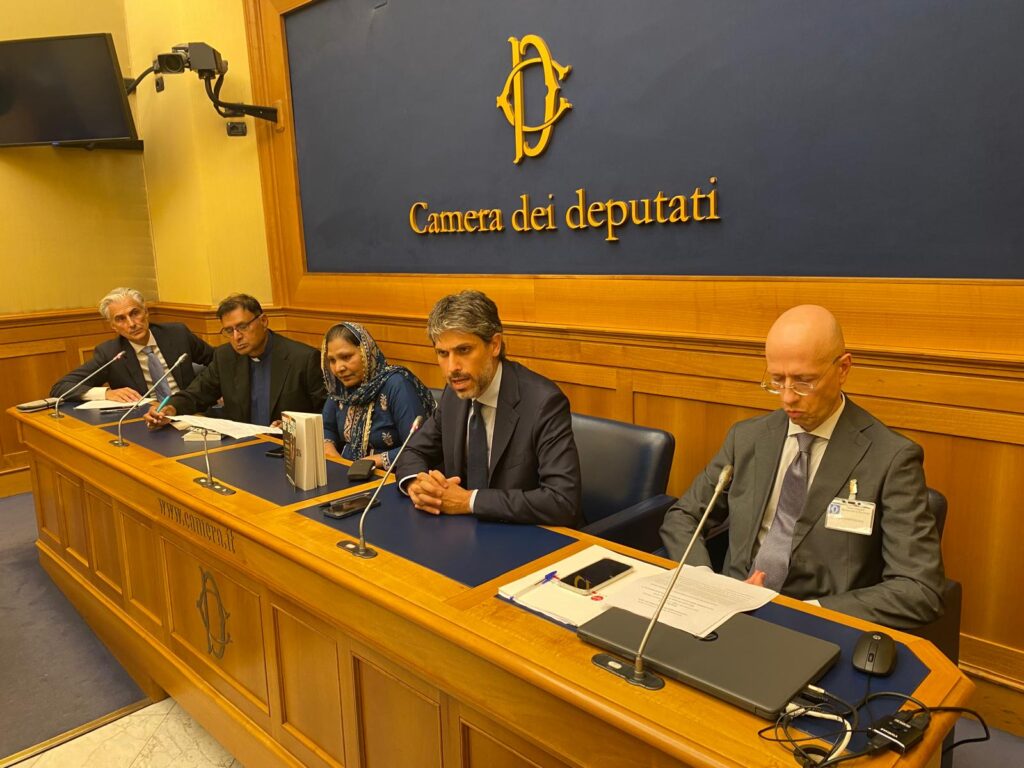
Rome, Italy – July 24, 2024 Italian legislators call on the country to employ all diplomatic channels to advocate for legislative reforms and other actions to address the persecution of the Christian community in Pakistan during a press conference in the Chamber of Deputies – the lower house of the bicameral Italian Parliament.
Shagufta Kausar: a mother’s faith in persecution – is the name of the press conference organised my Italian parliamentarian Lorenzo Malagola with Association of Pakistani Christians in Italy and Jubilee Campaign, Netherlands to address the misuse of anti-blasphemy laws and the rampant impunity surrounding forced faith conversions in Pakistan, the panelists and attendees fill the historic room.
Shagufta Kausar opens the event. She is a survivor of the anti-blasphemy laws and is all too familiar with the human toll of these egregious laws. Authorities in Pakistan arrested the Christian mother and her husband in July 2013 for allegedly sending blasphemous texts in English. Authorities later sentenced her and her husband to death under Section 295-C of the Pakistan Penal Code. She explains how she was offered multiple times to adopt Islam to avoid punishment by Pakistani officials. However, she refused to abandon her Christian faith even under the threat of death. “Christians in Pakistan are like sheep among wolves without a protector,” she explains. Kausar in her remarks, thanks Lorenzo Malagola and Professor Shahid Mobeen for organizing the press conference, allowing her to share her testimony of eight years in prison because of her faith. Thanks to international pressure, including a European Parliament resolution calling for her release, Shagufta and her husband were released from prison in 2021 but had to flee their home country shortly thereafter. Due to the shortage of time she references her recently released book Under Threat of Death: A Mother’s Faith in the Face of Injustice, Imprisonment, and Persecution, where she recounts in greater detail her harrowing experiences as a Christian facing a blasphemy accusation in Pakistan.
Lorenzo Malagola – a member of parliament in Milan and – emphasises the importance of freedom of religion as a core human rights value recognized and promoted both within and outside the EU. As a lawmaker he urges the Pakistani government to ensure that all religious minorities can practice their beliefs without fear or restriction. He brings attention to the discriminatory National Database and Registration Authority (NADRA)’s policy regarding the change of religion in national identity cards and raises concern with its discriminatory nature – restricting Muslim citizens’ religious conversion away from Islam. “This policy undermines the freedom of religion, expression, and identity,” he stresses that the human rights abuses in Pakistan are deeply alarming and require urgent attention and action.
Fr. Gilbert Shahzad with the Association of Pakistani Christians in Italy reiterates the plea to Italian parliamentarians and EU Member States to engage politically with Pakistan to abolish the death penalty and fulfill its human rights obligations. Pakistan must prioritize the protection of its religious minorities by passing progressive laws and creating an environment where all citizens can exercise their rights and freedoms without fear, he urges. Shahzad brings attention to the 12 recommendations that Pakistan received regarding repealing or amending blasphemy laws during its 4th cycle of the Universal Periodic Review (UPR) in January 2023, unfortunately Pakistan has failed to implement them effectively.
Joseph Jansen, a human rights activist with Jubilee Campaign, Netherlands; takes the floor describing the various forms of persecution that Christians in Pakistan. He outlines the human rights abuses inflicted by the misuse of blasphemy laws, mob lynchings, attacks on churches and Christian homes, honor killings, the abduction and rape of minor girls followed by their forcible conversion to Islam, and the widespread practice of bonded labor at brick kilns. “Pakistani authorities must strengthen their efforts in upholding laws meant to protect minority rights,” he urges, emphasising the importance of commitment from the judiciary, state government, and police to ensure justice. He describes how the situation of religious persecution and human rights violations has been deteriorating, despite the European Parliament’s 2021 resolution urging Pakistan to repeal blasphemy laws and criminalise forced faith conversions.
“Recent violent incidents underscore the urgent need for accountability and safeguards to protect religious minorities,” Jansen says emphatically pointing to the tragic mob attack in Sargodha in May 2024 which resulting in the death of Nazir Masih. He also describes the mob violence in Jaranwala in August 2023, which led to the destruction of 26 churches and 90 Christian homes.
Ms. Tabassum Yousaf, also an advocate, reiterates the call for action, urging the Pakistani government to combat violence against women, including domestic violence, forced marriage, and child marriage. The gross abuse of Pakistan’s blasphemy laws, where false complaints are often registered against innocent individuals to settle personal scores, fosters a climate of religiously motivated violence and persecution in several parts of the country, she warns.
Pastor Justin Bhatti also took the floor noting that UN treaty bodies monitoring the implementation of the Covenant on Civil and Political Rights (CCPR), Convention on the Elimination of Racial Discrimination (CERD), and Convention on the Rights of the Child (CRC) have all urged Pakistan to repeal all blasphemy laws or amend them in compliance with international human rights standards. “The misuse of blasphemy laws instills terror and fear among vulnerable groups and must be effectively addressed,” he concludes.
Massimiliano Tubani, Director of ACN-Italy, concludes the event, emphasising the need to protect religious minorities and enhance socioeconomic development efforts, “protecting the rights of religious minorities is essential for ensuring their safety and dignity.”
The parliamentary press conference urges Pakistani authorities to address grave human rights violations, prioritise socioeconomic development, and ensure the protection of all its citizens, regardless of their faith or belief. The broad, vague, and coercive nature of Pakistan’s blasphemy laws, which carry a mandatory death penalty is of serious concern. The panelists call on Pakistan to address these severe violations, in line with its international commitments. The speakers unite in their main call to action: the abolition of the death penalty, the release of individuals imprisoned for peacefully exercising their faith, the enactment of laws to criminalize forced faith conversions of minority girls and women; all to exemplify the Government of Pakistan’s commitment to respect, fulfil, and promote women’s rights and the rights of all its citizens regardless of belief.
Photos used with permission, taken by Joseph Janssen et. al with Jubilee Campaign NL