
This is the final installment of our reporting on our new publication, Stolen Girls, which seeks to document patterns of forced conversion, abduction, child marriage, and sexual violence affecting minority girls in Pakistan, and to highlight the legal gaps and institutional failures that allow these abuses to continue. You can click the links to view our previous emails, which discuss the geographic scope of cases, the age distribution of victims, judicial precedents, and historic parallels.
Pakistan’s Shameful Track Record
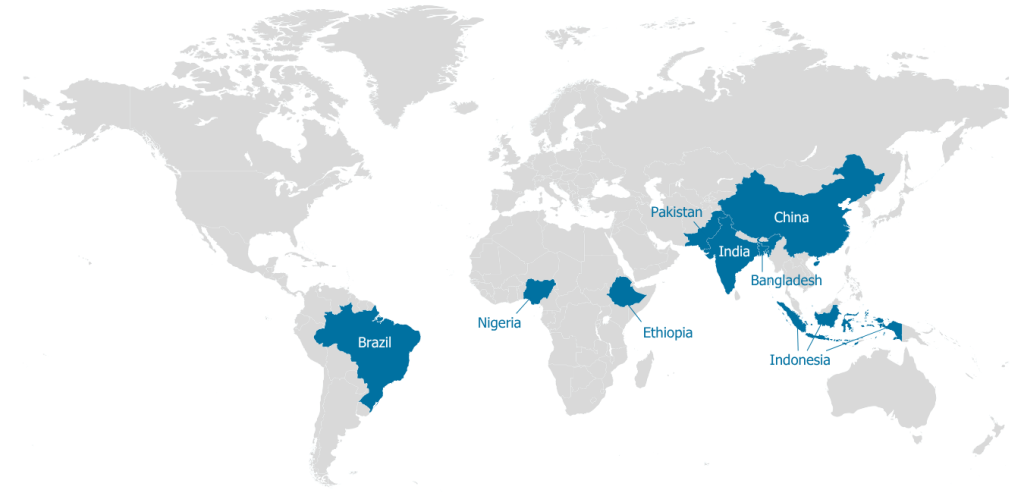
Per the Child Marriage Data Portal, maintained by UNICEF’s Division of Data, Analytics, Planning and Monitoring, Pakistan ranks 6th globally with regard to the number of child marriages below age 15, surpassed only by India, Bangladesh, Nigeria, Indonesia, and Ethiopia. Concurrently, Pakistan ranks one lower – 7th place – for marriages under the age of 18 years; higher frequency was recorded in India, Bangladesh, China, Indonesia, Nigeria, and Brazil.
One encouraging statistic, provided by UNICEF and based on nations’ Demographic and Health Surveys, is that the child marriage prevalence statistic in Pakistan has been steadily declining by an average of 5.25 percentage points every five years (approximately 1.05 per year).

Regarding the linear graph below, of the seven core global regions analyzed by UNICEF, South Asia has seen the largest decrease in child marriage rates over the past decade. Nevertheless, taking into account the fact that many nations in the top ranks for child marriage rates are geographically situated within South Asia – including Pakistan – the region’s overall burden remains second highest as of 2023-24 despite the laudable progress. We have included the rates of Sub-Saharan Africa (the most affected global region) and the World for comparison purposes.

The issue of coerced faith conversion in Pakistan has attracted sustained international concern and forms part of a broader assessment of the country’s human rights record. Governments, United Nations mechanisms, and international partners have repeatedly called for stronger protections for religious minorities, particularly girls at risk of child marriage, sexual violence, and coercion. In 2022, seven United Nations Special Procedures mandate holders sent a joint communication to the government of Pakistan, expressing concern about the abductions, forced conversions, and marriages of Mehwish Patras, Chashman Kanwal, Zarvia Pervaiz, and Saba Nadeem.

On April 11, 2024, UN human rights experts urged Pakistan to harmonize its laws by establishing a uniform legal age of marriage at 18 years for both males and females nationwide. They emphasized the necessity for enhanced legal protections to shield girls from minority communities, particularly Christians and Hindus, from forced religious conversions, abductions, and child marriages.
In April 2026, UN experts once again reiterated their disapproval of Pakistan’s inadequate response to reports of forced religious conversion and child marriage. While most cases involving Christian girls take place in Punjab province, the UN experts provide some additional context, noting that Sindh province is the backdrop of incidents involving Christian and Hindu minors alike. Citing recent statistics, the experts note that Christian minors make up 25% of victims and that certain other characteristics are common among targeted girls, notably being aged between 14 and 18 years and being from an impoverished background.
The Experts
⇒⇒ In January 2025, Catholic teenager Ariha Gulzar was abducted in a ambush upon her home in Punjab by 40-year-old neighbor Sajjad Baloch and two accomplices. The following day, Ariha’s father, Gulzar Masih, received a call from Sajjad threatening Ariha with rape and sex trafficking should Gulzar and his wife try to intervene further. Soon thereafter, Sajjad and his family vacated their residence, and despite Masih’s attempts to rouse police to act against his daughter’s kidnapper, to no avail. Two months later, in April, during a Lahore High Court appearance, Ariha claimed to have been 18 years old, a Muslim convert, and a wife to Sajjad. The judge, however, noticing Ariha’s visible duress, ordered the girl to be released from the custody of her ‘husband’ and returned to her family. Read Ariha’s full story
⇒⇒ In April 2026, two months into her apprenticeship with a local artisan, 41-year-old Muhammad Kashif, 13-year-old Maryam Asif Masih failed to return home one evening. The girl’s mother, Maria, received word from Masih’s wife that the man had taken Maryam and fled surreptitiously. Local police declined to intervene, forcing Maryam’s mother, father, and grandfather to appeal to a higher official. This Sub-Inspector reprimanded the lower police branch and instructed them to undertake efforts to locate and rescue Maryam. However, the local police became antagonistic towards the girl’s family, even telling Maria that her daughter would ‘never return’. Read Maryam’s full story