28 July 2026 | In her preliminary findings the Special Rapporteur drew attention specifically to tensions with plural legal systems in relation to blasphemy, personal status matters amongst others, and the loud alarm bells elicited by the widespread insecurity in the country.
“Discussion of freedom of religion or belief in Nigeria elicits very acute concerns about insecurity, violence and conflict which has spread throughout the country and has generated huge alarm,” she writes, “albeit to different intensities and for different reasons.” She describes with concern numerous human rights abuses with “the terrorist actions, gang violence and banditry incursions, land grabbing to mass displacement, armed conflict and cattle rustling, hostage taking to arson attacks, destruction of holy places and schools, large scale kidnappings in remote areas and civil unrest around protests and strikes, decimation of irrigated farmlands and whole villages and livelihoods, through endless cycles of threats, fear and death in expanding areas of the country.”
The destruction of places of worship can be seen in a recent news report released in July by the Swedish national public television broadcaster, Sveriges Television. Where journalist Johan Ripås visited and spoke with survivors of a recent Fulani militant attack in Bokkos, Plateau state, accompanied by a military escort. He documented the aftermath of the militant attacks, destroyed churches and burnt down homes. Jubilee Campaign also submitted a joint report prior to the Rapporteur’s visit documenting the impunity surrounding abductions and forced religious conversions of women and girls.
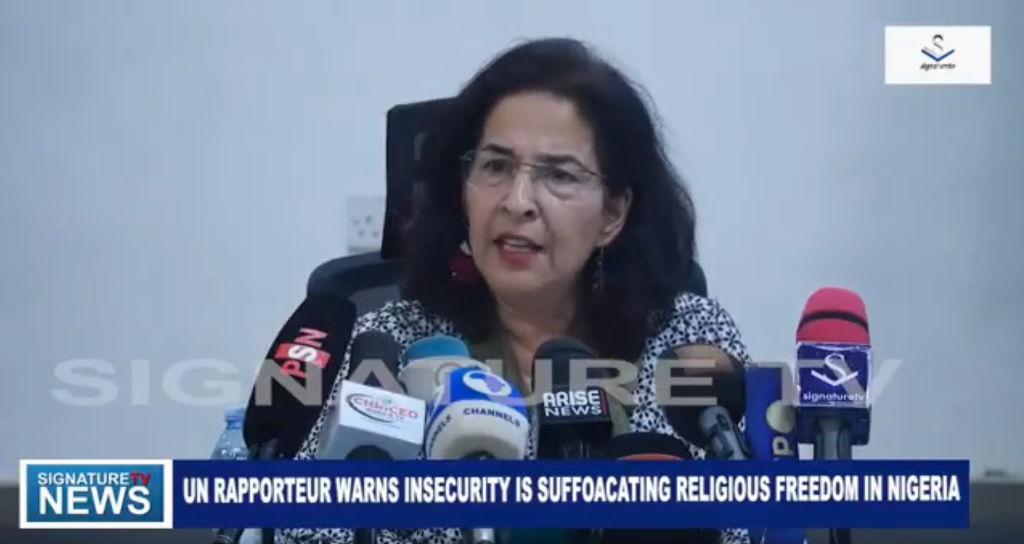
During her visit the Special Rapporteur was able to visit with over 200 interlocutors during her 11-day trip but was limited to two states in Nigeria due to the security situation, she says during the end-of-country-visit press conference: “We had a whole list of other places that we wanted to visit but we were forbidden for security reasons. We can’t fight that.” Despite the limited time and ability to move around freely the Special Rapporteur was able to meet with various religion or belief communities and organisations, faith-based actors, members of civil society organisations (CSOs), lawyers and academics across the three locations, Abuja, Jos and Kano state.
In her observations she addressed the security concerns head-on and notes how authorities often formally expressed, “lack of capacity to ensure security for all across this vast land.” She describes that she was able to visit an IDP camp and speak with a wide-range of victims. She describes how victims recalled “many bloody instances where the authorities did not show up when, for example, herdsmen violently attack in large numbers or mobs gather on an accusation of blasphemy. Notable examples which seized the nation include the Sunday Jackson case with respect to the former, and the Deborah Samuel case with respect to the latter.”
Her preliminary concluding observations can be found here and her full observations and recommendations will be presented in March 2027 in Geneva Switzerland. She promises that her full report will particularly address the tensions arising from parallel legal systems especially as it relates to anti-blasphemy legislation in light of international standards, “including the authoritative international guidance of the Rabat Plan of Action and its six-part threshold test warning of restrictions on expression only focused on content-based determinations.”