
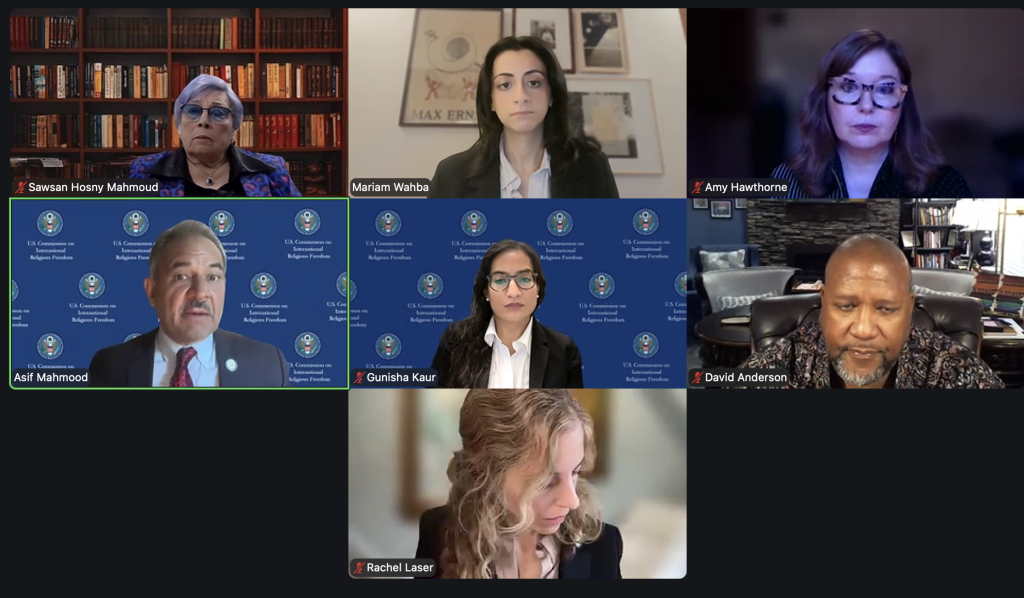
WASHINGTON, D.C., 5 November 2026 Anti-blasphemy laws were a major cause for concern to all speakers during the USCIRF-lead hearing on religious freedom conditions in the country of the pharaohs.
The speakers highlighted how the law has been used to target religious minorities particularly Christian converts from Islam. USCIRF’s April 2026 Country Update flags the 98(f) provision of the Egyptian Penal Code and notes that the government of Egypt has not “exhibited significant political will to repeal or revise this law or end the active prosecution of blasphemy cases.” Commissioner David Anderson asked the panelists for a priority religious freedom improvement to call for. In response, Mariam Wahba, research analyst at Foundation for Defense of Democracies, reiterated with speaker Amy Hawthorne – non-resident fellow at the Arab Center Washington DC – of the need to work for legal change, starting with the repeal of the anti-blasphemy law in Egypt. Amy defended her recommendation for legal change citing the legal changes regarding church construction which resulted in improvements, albeit incomplete. Legal change at least opens the door for accountability, she said. Mariam Wahba reiterated the sentiment, noting that: “If you focus on the law the culture will change eventually.” She expressed openness to a pragmatic approach with a narrowing or defining of the anti-blasphemy law as a first step before a full repeal.
Several religious prisoners of conscience detained under the infamous anti-blasphemy law were flagged during the hearing. USCIRF Commissioner and Chair, Dr. Asif Mahmoud, who moderated the event, raised with concern the arbitrary detention by Egyptian authorities of Christian apologist Augustin Samaan and atheist artist – Sherif Gaber. Mariam Wahba raised the arbitrary detention by Egypt of Christian convert Said Abdelrazek. All of whom are mentioned in USCIRF’s annual report and country brief update. USCIRF and the speakers called for their release and urged the US administration to raise both the anti-blasphemy laws and those detained arbitrarily under the law in Egypt in interactions with the Egyptian authorities.
Several congress members and senators provided pre-recorded videos including the co-Chair of the Egypt Human Rights Caucus, Rep. Don Beyer. The panellists emphasised the importance of including religious freedom when raising human rights concerns. Commissioner Laser warned that religious freedom is not just fine gestures [like President Sisi attending Christmas services] but the application of religious freedom, working for legal and institutional reforms. She also expressed marked concern with the impunity surrounding forced religious conversions and forced marriages of Coptic women and girls.
Sawsan Hosny Mahmoud, a Member of the Office of Public Affairs of the Bahá’ís of Egypt, spoke extensively regarding the discrimination and marginalisation of Bahais in Egypt. She gave examples of Egypt denying the registration and recognition of marriages between Bahais. USCIRF Commissioner Gunisha Kaur expressed genuine interest in this issue. The hurdles surrounding personal status laws of Bahais is also included in the USCIRF Country Update on Egypt.
In addition to concerns regarding the Christian and Bahai minorities in the country, the panellists flagged the Egyptian government’s attempted seizure of the world’s oldest monastery, St. Catherine’s in Sinai, as well as the forced reconciliation committees in response to mob violence by intolerant Muslims following the building of a church or other places of worship in a Muslim majority area. Marcus Sheff, CEO of The Institute for Monitoring Peace and Cultural Tolerance in School Education illuminated how schoolbooks perpetuate the discrimination and segregation faced by non-Muslims and other religious minorities, including Jewish people and Ismaili Muslims. All the speakers were clear that religious freedom concerns need to be on the table in US dialogue with Egypt including the release of religious prisoner of conscience, while working for legal change.
The USCIRF hearing on Egypt marks the first country-specific hearing on the country in 10 years. Egypt has, however, been mentioned in at least four USCIRF hearings and conversations under thematic topics. USCIRF recommends Egypt be placed on the Special Watch List of countries which have “engaged in or tolerated severe violations of religious freedom” but do not meet all the criteria for being designated as a Country of Particular Concern. In response to a question on the impact of a Special Watch List designation, the panelists said it ensures religious freedom is a forceful priority in US dialogue with Egypt and puts pressure on the lack of will in Egypt to take actionable steps to improve the current freedom of religion and belief conditions.