
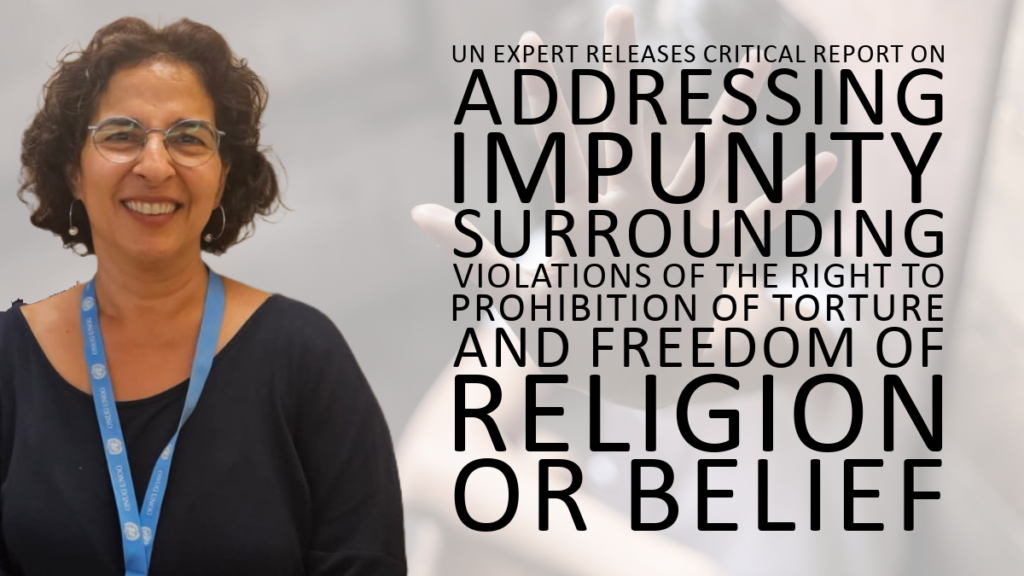
14 February 2025 – Geneva, Switzerland | “The ultimate goal of the present report is to honour the victims of such violations […] recommending a framework that will minimise the chances of repeated violations taking place again.”
This report marks the UN Special Rapporteur on freedom of religion or belief (FoRB) Dr. Nazila Ghanea’s fifth report, which will be presented at the upcoming Human Rights Council session that kicks off next week. Dr. Ghanea notes that she receives numerous communications on violations of freedom of religion or belief that, “appear to reach the threshold of torture and ill-treatment.” She expresses concern that, despite this, there are numerous instances where states, state officials, courts, treaty bodies and even those working directly with victims have “not adequately taken both rights in consideration in cases [leaving] them exposed to future abuse.”
Recognising where FoRB and prohibition of torture violations overlap – opens avenues for accountability
Dr. Ghanea’s report outlines why identifying both rights are important for more effective accountability: “The most egregious violations of freedom of religion or belief which involve torture and ill-treatment can be prosecuted by any state in the world.” Dr. Ghanea provides the Jesuitas Case as an example of when individuals can be prosecuted in jurisdictions other than those in which the human rights violation took place, specifically when a violation of FoRB also constitutes a violation of the prohibition of torture, a ius cogens norm. Inocente Montano – a former military commander from El Salvador – responsible for the brutal murder of five Jesuit priests in El Salvador, was prosecuted in Spain, 31 years later for the massacre he led. Dr. Ghanea notes, “This case demonstrates that despite jurisdictional barriers, by framing them into precise legal definitions, there is a higher likelihood that such cases can be successfully prosecuted, and justice can be done for victims and their families.”
Identifying where FoRB violations overlap with the absolute prohibition of torture opens up additional avenues to pursue justice and accountability, including more jurisdictions.
However, only a few cases adjudicated by the Committee Against Torture have recognized individuals who suffered torture because of their religion or belief. In contrast, there are several instances where violations occurred in the name of religious norms and non-refoulement. Dr. Ghanea suggests this lack of representation is not due to a lack of cases of freedom of religion or belief violations that reach the threshold of torture, but rather a blind spot in identifying how various acts of coercion could amount to a violation of the prohibition of torture and ill-treatment. She reiterates that both rights should be taken into consideration equally, “the equality of rights also supports the fact that Special Procedures regularly issue join communications and raise relevant rights […] Not all forms of coercion reach the threshold of torture or ill-treatment, but all forms of torture inflicted on person on the grounds of their religion or belief constitute coercion.”
She continues, “the intersection of freedom of religion or belief and the prohibition of torture and ill-treatment is evident in the concept of coercion in article 18 (2) of the ICCPR – which strictly prohibits coercion aimed at changing an individual’s religion or belief – and in the definition of torture in CAT.”
“Physical coercion will have physical and psychological effects on individuals, and vice versa. That said, it is easier to demonstrate evidence of physical coercion than psychological coercion, and the latter has oftentimes been overlooked,” she also notes in her report.
“Acknowledging violations of both rights in these contexts shifts the focus towards protecting the shared non-derogable forum internum of both rights, and provides victims with more appropriate remedies for the life-long impacts of their ill-treatment.”
Systemic discrimination, Coercion, Impunity
Dr. Ghanea also provides an example of how the distribution—or rather, the non-distribution—of aid can be a tool for coercion: “The African Commission on Human and People’s Rights found that the Sudan had violated the rights to freedom of religion or belief and the prohibition of torture in a case where non-Muslims were coerced to change their beliefs through denial of work, food aid and education. The Commission stated that ‘these attacks on individuals on account of their religious persuasion considerably restrict their ability to practice and freely the religion to which they subscribe.’”
The UN Special Rapporteur urges that violations of religion or belief rights be taken seriously in legal cases, “far more needs to be done to address such violations and develop effective preventative measures to prevent impunity.” She expresses surprise in, “how few legal cases related to these rights have been entertained by international bodies, given the number of violations reported by civil society organisations and the number of allegation letters received under the mandate.” She remarks: “Those involved in the determination of torture and ill treatment must understand the contextual religious and philosophical issues at stake to define more precisely the severity of the pain inflicted on victims.”
Dr. Ghanea points out that only 12 states are not party to the International Covenant on Civil and Political Rights or the Convention Against Torture [and even so, the mandate notes, that the same 12 states are party to the Convention on the Rights of the Child which include similar provisions].
The prohibition of torture is absolute (para. 20) and admits no limitation or restriction whereas FoRB – is absolute in its internal aspect, forum internum and other restrictions on FoRB must still fulfil the “necessity, proportional, legality.”
“When torture methods employ forced engagement in practices against the religion of the victims, this should be considered a violation of both rights,” she concludes, “[only] By taking these rights seriously can the plight of victims and their suffering be addressed more adequately. “
Deprivation of Liberty
Her report goes on to highlight examples within the context of “places of deprivation of liberty”. With regards to soft law in this area, Dr. Ghanea points to four key documents:
- The United Nations Standard Minimum Rules for the Treatment of Prisoners (the Nelson Mandela Principles)
- The Manual on the Effective Investigation and Documentation of Torture and other Cruel, Inhuman or Degrading Treatment or Punishment (Istanbul Protocol), as revised
- The United National Rules for the Protection of Juveniles Deprived of their Liberty
- United Nations Rules for the Treatment of Women Prisoners and Non-custodial Measures for Women Offenders (the Bangkok Rules)
She outlines clearly that the right to freedom of religion or beliefs “is not suspended for detained individuals.” The Nelson Mandela principles for example outline that the prisoner has the right to continue to enjoy their rights to manifest their religions or belief, including participating in religious and spiritual activities, and being able to keep religious books and receive visits from spiritual and religious representatives, and equally, “not forced to take part in religious practice nor receive visits from religious representatives not aligned with their beliefs.” Jubilee Campaign in our written statement to the Special Rapporteur on prohibition of torture, reported on cases of these violations in the case of Mariam Ibraheem and more recently Nigerian Humanist Mubarak Bala, who was released last year. In addition, Abdulbaqi Saeed Abdo who was released a month ago shared how Egyptian authorities denied him the right to a Bible and when he was found to be sharing Bible verses on pieces of paper with fellow prisoners of conscience authorities punished them by placing them in solitary confinement.
The Istanbul Protocol lists several examples of torture methods, including what is defined as, “behavioural coercion,” one example being “forced engagement in practices against the religion of the victim (e.g. forcing Muslims to eat pork). Jubilee Campaign in its written submission to the UN Human Rights Council shares the survival story of Mariam Ibraheem who faced pressure from authorities to return to Islam in prison. The report describes how in Nigeria, authorities forced Mubarak Bala – an exMuslim Humanist- to engage in Muslim prayers. She notes that knowledge that subjecting a victim to a certain form of ill-treatment will target their religion or belief, “may elevate the severity of the ill-treatment so as to make it an objective act of torture.”
“[…] the knowledge that subjecting a victim to a certain form of ill-treatment will target their religion or belief may elevate the severity of the ill-treatment so as to make it an objective act of torture.”
She raises the importance of religious chaplains and other religion/belief leaders knowing about these frameworks as they can, “play a pivotal role in reporting torture and ill-treatment in places of deprivation of liberty.”
She also outlines the various negative and positive obligations states are responsible to fulfil. Not only must states not commit torture or coerce anyone to change their religion or belief [Article 7 ICCPR and Article 18(2)], “States must also take preventative measures to ensure that violations of these rights do not occur.” [our emphasis]. The recommendations of the Special Rapporteur’s report are two-prong the importance of knowledge but also actions on prevention and accountability.
The UN Special Rapporteur urges states and civil society to “step up” and effectively recognise FoRB violations in the context of torture for better accountability and closing the gap on impunity of these grave human rights violations.
The UN Special Rapporteur’s report is timely. Her next report equally so and will address violations of freedom of religion or belief in the context of displacement.
Thank you Jubilee Campaign for a precise and synthetic picture of what really is going on in several forms of torture related to the lack of religious freedom and belief!