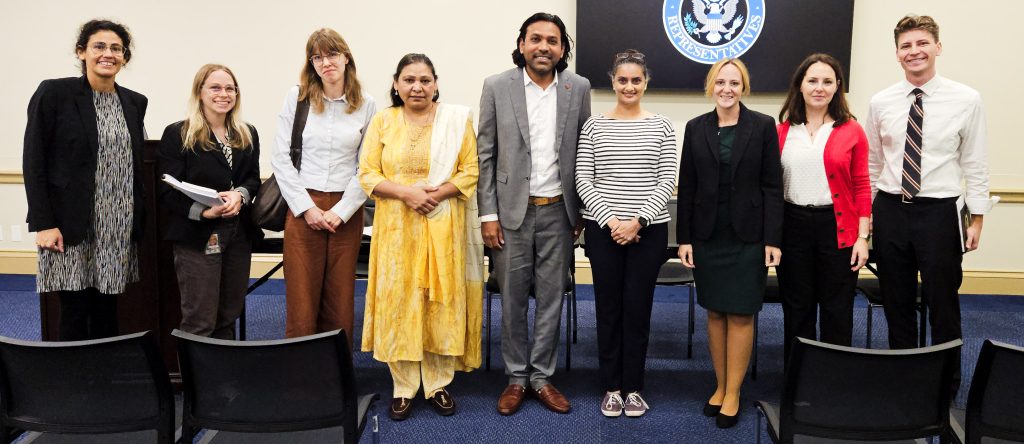
WASHINGTON, D.C., 13 October 2026 | Impunity for state-facilitated forced religious conversions and child marriages involving Christian and other minority girls, extrajudicial killings, and the arbitrary detention of individuals accused of blasphemy are the key issues Jubilee Campaign, ExMuslims of North America and the United States Commission on International Religious Freedom raise during the Jubilee Campaign-organised staff briefing with members of the House Foreign Affaris Committee, calling for urgent action and accountability.
The room fills with civil society actors and staff representatives from the Congressional offices of Rep. Young Kim, Rep. Bill Huizenga – Chair of the South and Central Asia Subcommittee, Rep. Marlin Stutzman, Rep. Pramila Jayapal and Rep. Chris Smith, co-Chair of the Tom Lantos Human Rights Commission. On the panel is Pakistani-born human rights advocates and survivor of Pakistan’s anti-blasphemy laws, Shagufta Kausar.
Joseph Janssen, Chairperson of Voices for Justice and Advocacy Officer at Jubilee Campaign Netherlands begins by presenting their findings from the Stolen Girls report. The report documents 210 cases of abduction, coerced religious conversion and forced marriage involving Christian girls across Pakistan between January 2019 and December 2025 and is an update to the first report released in 2022. The earlier report was referenced in the National Commission of Human Rights report Drivers of Forced Conversion Through Marriage in Pakistan, noting the weak enforcement of laws which, “not only violates rule of law but erodes public trust in legal institutions.”
He emphasizes that “protecting a child is a duty of the state. Religious claims cannot excuse an abduction, and a marriage certificate cannot erase a child’s age.” He describes the long process for families to try and get justice. He shares the difficulties in just getting the police to file a First Investigation Report, the discrimination of the courts and insititutions blindly accepting falsified documents, the failure to investigate coercion and the willingness to accept the forced statements by the abducted girl, all aspects leaving the children exposed to the very people from whom they need protection. Janssen highlights specifically the case of Maria Shahbaz, abducted from Lahore in July 2025 while still a child, alongside Amber Nadeem, Sataish Mariam and other girls whose families continue to seek protection and justice and shares a video the families’ plea to lawmakers, to bring back their daughters.
Janssen concludes: “Freedom of religion means freedom to choose. It cannot be built on threats, isolation or captivity,” he says. “No girl should be prevented from returning to her family or practising her faith because someone threatens her with consequences for leaving a religion she was pressured to adopt.”
Aysha Khan, the second panelist and project manager with ExMuslims of North America (EXMNA), presents on Pakistan’s life-threatening anti-blasphemy laws. She describes how, contrary to the laws’ apologists, the existence of the law has led to more violence and instability. She describes the murder of Governor Salman Taseer as an example.
She challenges the view that anti-blasphemy laws are only misused, emphasising how they restrict freedom of religion and belief and expression: “This is not simply a problem of laws being misused,” says, “It is also a problem with what the laws prohibit.” She expounds, explaining that freedom of religion, “must include the right to change one’s beliefs, reject religion, and criticize religious ideas.” She notes that Pakistan has ratified the International Covenant on Civil and Political Rights, which protects freedom of conscience, religion, and expression but its anti-blasphemy laws continue to place certain religious ideas beyond permissible criticism, many times with, “potentially fatal consequences for those accused of crossing that boundary.”
She describes the far-reaching arm of the anti-blasphemy laws in the digital space, even impacting EXMNA’s own platforms. In 2025, Pakistan’s telecommunications regulator reported blocking more than 100,000 URLs classified as blasphemous, while authorities have also pressured social media platforms to remove content deemed offensive to Islam, “EXMNA has encountered these restrictions directly. WikiIslam, our online resource examining Islamic texts, teachings, and history from a critical perspective; has itself been blocked in Pakistan,” Ms. Khan says.
While she welcomes the reduction of blasphemy-related prosecutions, following Pakistan’s 2025 crackdown on the hardline Islamist group Tehreek-e-Labbaik, she makes clear that: “Religious extremism cannot be defeated simply by arresting extremists. A society must also be free to challenge the ideas that sustain intolerance, with institutions that protect those who do.” She continues: “A functioning democracy must protect people from threats, discrimination, and violence. It should not protect ideas, religious or otherwise, from criticism. These freedoms are not obstacles to Pakistan’s stability or prosperity. They are essential to both,” she also references H.R.5271 – Pakistan Freedom and Accountability Act. She notes that the steps taken by Pakistan to reduce blasphemy-related mob violence and arrests were taken due to concerns by Pakistan over losing preferential trade access to European markets, “Congress should build on this lesson by making freedom of religion, conscience, and expression a consistent part of US-Pakistan economic and diplomatic engagement.”
Aysha Khan expresses support for the recommendations made by the United States Commission on International Religious Freedom (USCIRF). Hulda Fahmi with Jubilee Campaign, moderating the briefing, reads out USCIRF Chair, Asif Mahmood’s, remarks. He welcomes the State Department’s Country of Particular Concern (CPC) designation of Pakistan in December 2023 but urges that the State Departments makes it effective by lifting the national secuirty waiver. USCIRF has been recommending Pakistan as a CPC since 2002, especially raising concern with the countries anti-blasphemy laws and the government’s inability to stop the widespread forced religious conversion and child marriage cases of Hindu, Sikh and Christian women and girls.
Shagufta Kausar, a Christian survivor of arbirary detention on blasphemy charges for over seven years, on death row, describes how women in the prison would try and convert her to Islam. They would approach her and tell her if she just says the shahada she can receive better conditions in the prison and eventually be released. Shagufta refused to be coerced and was eventually granted her freedom after international pressure following a European Parliament resolution calling for a release and conditioning the release to the European Parliaments’ GSP+ trade agreement. Joseph urges the U.S. congress to similiary use such pressure to free the girls from their abductors.
Jubilee Campaign calls on congress to pass the Pakistan Freedom and Accountability Act, which calls on President Trump and the Secretary of State to “strengthen engagement with the Government of Pakistan to ensure democracy, human rights, and the rule of law are upheld”, H.Res.594 – Condemning the persecution of Christians in Muslim-majority countries, which gives explicit visibility to the religious freedom violations against Christians in Pakistan, noting that: “Christians are regularly accused of blasphemy and face mob violence and the death penalty; Christian girls are regularly kidnapped and forced into marriages and conversions; and Christian cemeteries and churches have been attacked.” Jubilee Campaign also asks for Pakistan to be mentioned in H. Res. 738 – Expressing concern regarding severe restrictions on religious freedom abroad or at least call for countries which maintain the death penalty for apostasy or blasphemy to be designated as Countries of Particular Concern.