
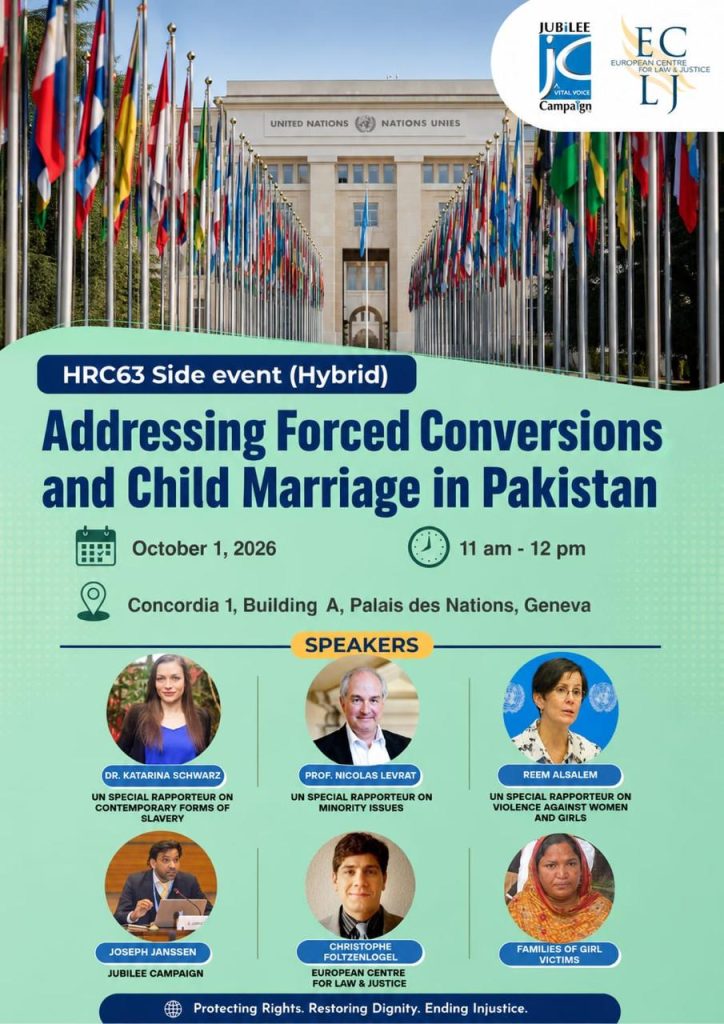
GENEVA, Switzerland, 1st October 2026 Three UN Special Rapporteurs join UN Human Rights Council side-event to remind Pakistan of its international human rights and domestic law obligations to protect its children against slavery and sexual violence, and uphold human rights.
“We don’t know where they are keeping her […] We have terrible thoughts about what is happening to her,” the mother of Maria Shahbaz pleads in video playing in the Human Rights Council side-event room Concordia 1; “Help us bring our daughters back,” is the appeal that echoes from the families of girls abducted and forcibly converted by their Muslim neighbours.
Professor Nicolas Levrat, UN Special Rapporteur on minority issues provides the keynote statement. His position is clear, the impunity surrounding forced religious conversions, “will not be solved by new laws or legislation.” He notes that Pakistan has ratified the Convention on the Rights of the Child and that the rights of children are explicitly stated there; the practice of forced religious conversion and child marriage violate Pakistan’s international and domestic law commitments. Prof. Levrat, UN Special Rapporteur on minority issues, expresses opposition to legislation banning forced religious conversion noting that – internationally – such legislation is always applied discriminatorily by the majority religion against minority religions. Prof. Levrat instead appeals to the Pakistani authorities to ensure better access to justice for minorities, referencing the opening testimonies of the families where the father of Maria Shahbaz described how the family went from court to court and “nothing happened.” Professor Levrat calls for training and technical cooperation of law enforcement and legal authorities. He does not disregard legal appeals, but emphasises that there are several hurdles to protecting the rights of the child that need to be tackled in tandem – the laws but also education to counter the societal pressure against minorities. “This has to be worked on,” he says, noting there is a widespread bias in favour of the dominant group, “the authorities need to seriously consider the complaints – issue justice,” Prof. Levrat concludes.
Joining online Dr. Katarina Schwarz, an international and comparative legal scholar with extensive experience on contemporary forms of slavery, human trafficking, and related forms of exploitation and the newly appointed Special Rapporteur on contemporary forms of slavery and trafficking in persons, raises how child marriage falls under the category of slavery. She clearly describes how slavery does not occur in a vacuum but often foments in an environment of discrimination and often targets women and girls. She adamantly defends the legal position that responsibility to protect the girls rests with the state. She urges Pakistan to work preventatively and implement “Robust and effective protection to fulfil their obligation.”
Joining online as well, the Special rapporteur on violence against women and girls, its causes and consequences, Reem Alsalem, opens her statement with a clear outline of the legal frameworks for the protection of women and girls in Pakistan. She is positive to the passing of the Child Marriage Restraint Bill 2026 which passed in Punjab and came into force in May 2026, setting 18 years as the minimum legal age for marriage for both boys and girls and declaring underage marriage a non-bailable offence. Section 5 of the law also made cohabitation with a child resulting from such a marriage as child abuse, regardless of the child’s consent. The passing of this bill in Punjab is significant, as Punjab is the state where the majority of abductions and forced religious conversions of Christian girls occur, as noted in Jubilee Campaign’s report “Stolen Girls.” The Special Rapporteur, Reem Alsalem, notes with concern the inconsistent application of these laws, however, where accountability often was dependent on which court and the level of engagement by the lawyers. She also describes how lack of accountability is exacerbated due to pressure on victims and families to withdraw complaints by the abductors and sometimes even law enforcement.
Christophe Foltzenlogel, advocacy officer with the European Centre for Law and Justice, expounds on the backdrop of discrimination of minorities, particularly against Christian minorities, in Pakistan. He describes the slow justice system, specifically in an anti-blasphemy law case: “Consider Shahzad Masih. He was just 16 years old when [authorities] arrested [him] in 2017 simply for repeating a conversation.” He says that even though the police commissioner testified that Shahzad’s words were not insulting, because of immense pressure from fundamentalist groups who pack the courtrooms to intimidate judges, the court refused to try him as a minor and sentenced him to death in November 2022. Shahzad Masih recently told his lawyers: “They should just hang me. I cannot bear this suffering of waiting every single day.”
Christophe Foltzenlogel joins his co-panelists in emphasising that Pakistan has the laws but is not implementing them. He spotlights the mishandling of justice in forced religious conversion cases and woefully notes that there is more care given to intangible objects that have been stolen than the abduction of a human life. In cases of theft the object is sought out and placed under police custody or returned to its owner but even now, 13-year old Maria Shahbaz – abducted by a 30 year old man – remains under the control of her abductor, “the thief.”
Joseph Janssen, Pakistani human rights advocate and advocacy officer with Jubilee Campaign, has met with survivors of forced religious conversion and abductions. He outlines the extent of the problem drawing from Jubilee Campaign’s report “Stolen Girls.” He describes what took place in the court during one of the most recent cases of a minor who was forcibly converted and married off to an older Muslim man, Amber Nadeem. He says, “I personally witnessed lawyers arguing that because she had converted to Islam, she could not return to her Christian parents, as this would constitute apostasy. Her status as a child was being pushed aside.”
This speaks to the societal pressure described by Professor Nicolas Levrat, noting that there are injustices that need to be confronted in tandem with the legislative and other advocacy to secure sustainable protection for minorities today and tomorrow, recognising minorities as equals in dignity and rights.
“Maria Shahbaz’s case has been raised locally and internationally, including at the European Parliament and the United Nations,” Joseph Janssen concludes, “Yet she remains in the custody of her alleged abductor and purported husband. Why has she still not been placed in government protective custody, away from those accused of harming her?” He echoes the plea of the families: Pakistan needs to rescue the girls from their abductors while they wait for justice and heed the international and domestic calls for implementation of existing laws and not just lip service; Maria Shahbaz and others need to be returned to their parents.
“No response yet,” Prof. Nicolas Levrat says in response to a question about what has happened to the the UN Special Procedures’ communication which raised concern with the impunity surrounding forced religious conversions and abductions of women and girls in Pakistan. The communication was followed up several times with press releases including most recently in April 2026, noting that the scale and persistence of these human rights violations, “point to systemic discrimination against non-Muslim women and girls who are forced or compelled to convert to Islam in order to marry Muslim men.” The Special Procedures in that release called on the government of Pakistan to: “intensify efforts to eradicate forced conversions, to raise the minimum age for marriage to 18 in all provinces and territories, to criminalise forced religious conversion as a distinct offence and to enforce applicable laws pertaining to human trafficking and sexual violence.” The implementation of the recommendations is yet to be seen but the panelists’ hopes are that this side-event will be a reminder to Pakistan to put the plight of Pakistan’s daughters on the top of their agenda, to bring them back to safety and rescue them from the grasp of their rapists and captors.