
WASHINGTON, D.C., 12 November 2026 Over one year since the CPC designation of Nigeria, Congress is calling for measurable results to end the killings, abductions and rape of civilians by armed groups especially against Christians in the Middle Belt of Nigeria.
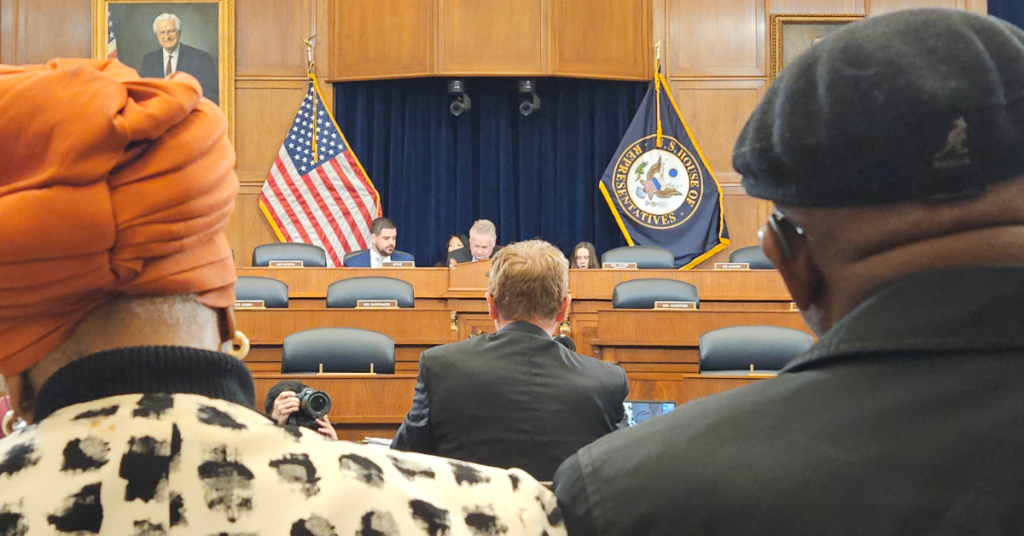
Rayburn House Office 2172 was packed when the hearing on Nigeria was called for with a line outside of attendees who could not make it in. The room emptied out slightly for the second panel of witnesses when the US government officials left, including several of the congress members. Congress members in the room for the first panel included Congressman Chris Smith from New Jersey who Chairs the House Foreign Affairs Subcommittee, Ranking Member and congresswoman Sara Jacobs, congressman Bill Huizenga, congressman Riley Moore, congressman Jonathan Jackson, congressman Johnny Olszewski, and congressman Mark Pocan.
Congressman Smith opened the congressional hearing titled, “One Year Later: Assessing Nigeria’s Efforts to Protect Christians and Secure the Middle Belt,” and explained the dire situation in Nigeria in his opening statement and the need for action, reiterating that the Country of Particular Concern (CPC) designation is “only the first step.” Rep. Huizenga likened the lack of action from Nigeria’s government in Abuja to the Hunger Games, where the elite are “out of touch with what is happening in the other states. It’s a tragedy,” he said.
“The standard should be effective policy and measurable results,” Ms. Oge Onubogu Director and Senior Fellow Africa Program Center for Strategic and International Studies, and speaker on the second panel, shared.
Congress members and the experts were unanimous in wanting to see results in Nigeria to end the violence against Christians and other in Nigeria, not posturing. “Steps are not results,” Rep. Riley Moore said and gave examples from Benue state where a priest had to close schools and his church because of the insecurity. Rep. Riley Moore said, “success means a definitive end of the genocidal murder and the internally displaced persons’ peaceful return to their ancestral homelands.”
Rep. Moore and Rep. Huizenga also urged the US state representatives on the witness stand that the CPC designation cannot be lifted. The Honorable Riley Barnes Assistant Secretary Bureau of Democracy, Human Rights, and Labor U.S. Department of State outlined a key reason why Nigeria cannot be taken off the CPC, the continued enforcement of its anti-blasphemy laws including the 12 Nigerian states allowing for “penalties up to execution for blasphemy.” He said in his opening remarks: “Another tragic situation in Nigeria is the continued enforcement of blasphemy laws. State-level officials unacceptably continue to prosecute individuals for alleged blasphemy – or perceived insults to Islam – including peaceful speech, which stands in clear violation of Nigeria’s obligation to safeguard expression and religious freedom one additional compelling argument to why Nigeria cannot be taken of the CPC designation.” He also noted that the US is “actively pressing the Government of Nigeria and calling for the release of Sufi singer, Yahaya Sharif-Aminu , who sits on death row over blasphemy charges.” He shared that in addition to the singer’s release the US is pressing the Government of Nigeria to “repeal its blasphemy laws, or at a minimum to move to non-enforcement.”
Several references were made to a statement by Under Secretary of State Allison Hooker during the hearing noting that, “Progress has not been adequate.” Ms. Hooker visited Nigeria in January 2026 and met again with the newly convened US-Nigeria Joint working group in Washington DC in August 2026. Garcia who shared the Under Secretary’s assessment was still hopeful for change, “as Hooker said progress has not been adequate, but it does not mean Nigeria is dismissing concerns and are not taking action.” Garcia did admit though, “It has not had an impact to this point.” He shared that the goal of the US-Nigeria joint working group is to, “have accountability with the Nigerians so that we can get moral outrage into an accountable architecture.”
Attention was brought during the hearing to the Fulani militant attacks in the Middle Belt, which receives limited attention in international media. Several congressional members specifically highlighted the arrest of Mahmoud Adam in the Middle Belt and ensuring he was prosecuted. Rep. Moore questioned the Assistant Secretary Garcia, “Are they going to charge him? Are you going to put pressure to prosecute him?” Rep. Moore said that prosecuting Mahmoud should be, “a real eyeopener if they [Nigeria] are not able to do that, some type of justice needs to be brought in that case.” Assistant Secretary Garcia assured that this was the US administration’s wish too, to see a prosecution. Rep. Smith also warned that an increased number of arrests means nothing with few convictions and no jail time – he gave examples of how this was a tactic of states to evade accountability in his anti-trafficking work, “A number of countries would give large arrest numbers but few convictions [this is] trivial for these egregious abuses.” He continued, “We need action. Talk is cheap in Washington and other capitals around the world.” He pressed the US government witnesses on actionable steps and asked, “How below expectations are they [the Nigerian government]?” Garcia responded: “Nigerians placement is in building capacity, and it is not being effective or moving fast enough, but we see a deployment underway.”
Rep. Moore referenced the strikes which killed ISIS-leader al-Minuki but noted that the “counterterrorism fight does not disable the Fulani militants acting in the Middle Belt.” Garcia mentioned that the administration are pushing for action in the Middle Belt, “We are looking at core action in the Middle Belt. Moving troops forward are all steps in the right direction. We expect operations and decapitating strikes against the Fulani militia.” Under-Secretary Riley Barnes said we are seeing action by Nigeria in “Building the trellises to secure these people but not the data that backs it up,” and emphasised that the administration are with congress in the desire to see results, “[Nigeria] are sending signals and doing something – we are expecting results.”
The elections were also brought up by both sides of the house and the importance of them being monitored. “Watch the elections like a hawk,” Rep. Riley Moore said.
Rep. Chris Smith also asked Nina Shea, Senior Fellow and Director Center for Religious Freedom The Hudson Institute – during the second panel, if the Fulani militants could be added to the “entities of particular concern.” Nina Shea agreed that this should be looked at very carefully and added that the US government should request intelligence on the actions of the Fulani militants, “There is a need for intelligence on its leadership and financing,” she said. She noted how the Fulani militants had become increasingly radicalised and were borrowing tactics from other terror groups.
Nina Shea also warned about the lobbyist groups who are trying to discredit and further deny the reality on the ground. Rep. Smith is aware of this and recalled Romania’s efforts to pay actors to provide a pretty picture of their country when it came to religious freedom while bulldozing churches and arresting Christians.